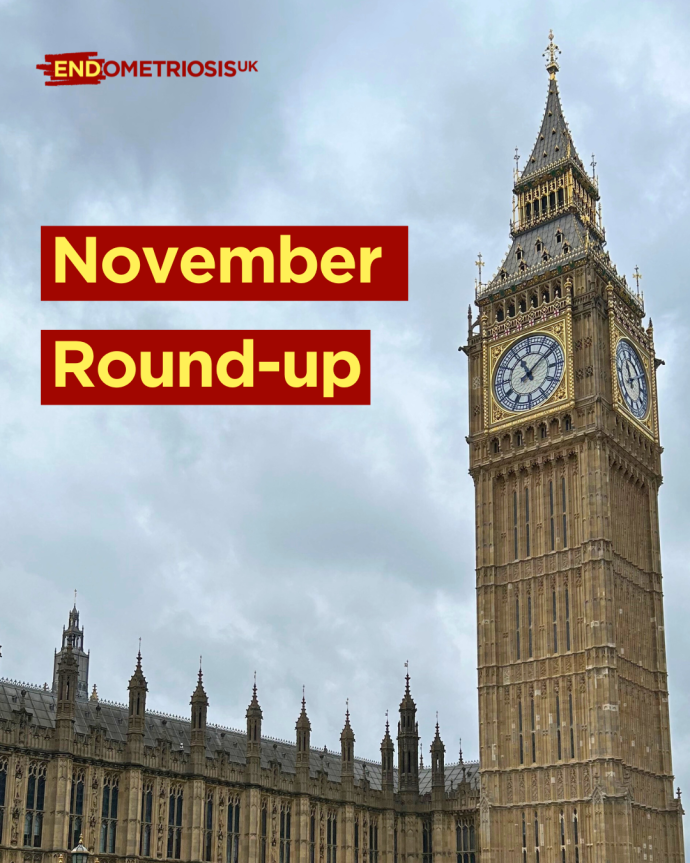
It’s been an exciting month, as we’ve attended numerous roundtables in Parliament, supported the All-Party-Parliamentary Group (APPG) on Endometriosis panel on endometriosis in the workplace, hosted our own roundtable on the NHS 10 Year Health Plan, and given oral evidence to the Women and Equalities Select Committee Inquiry on young people. We also met with numerous parliamentarians across all 4 nations including officials in Wales and Scotland, and with Órlaithí Flynn MLA to discuss the women’s health action plan that is due to be released in Northern Ireland over the coming year.
Read on to find out more about what we’ve been up to this November, and how we’ve been raising your voices in Parliament.
Endometriosis UK hosts roundtable on NHS 10 year Health Plan
This month we were delighted to host a roundtable sponsored by Gill Furniss MP on what the Government’s 10 Year Health Plan could mean for the future of endometriosis care. We were joined by Members of Parliament, patient advocates, and leading experts in endometriosis and women’s healthcare to discuss various topics. These included how the Government can bring down the average time to diagnosis, how Neighbourhood Health Services can be implemented to ensure improved access to high quality, effective management and treatment, and what the Government should include in the renewed Women’s Health Strategy.
We had a productive session on what the future of endometriosis care should look like, and we are now producing a report that will be delivered to the Department for Health and Social Care, that we hope will support the implementation of the 10 Year Health Plan and the renewed Women’s Health Strategy.
Keep your eyes peeled on our website and social media channels for further updates and information. The report will be made publicly available in the coming months.
Improving young people’s health outcomes: Endometriosis UK gives oral evidence for the first time in Parliament
Children's health has been in the spotlight this month, and rightly so. Getting it right for children and young people can shape someone’s entire future. A life course approach is vital for endometriosis care, and that starts with ensuring everyone knows the symptoms of menstrual health conditions, what is and isn't normal, and how to seek help when they need it. Learning about the menstrual cycle at school, in an age-appropriate way for all genders, is what we need to achieve. This relies on teachers and educators having the information they need, as well as schools understanding the importance of menstrual education and ensuring it’s appropriately delivered, and Governments ensuring schools are delivering menstrual education.
Improving menstrual healthcare for young people relies on the healthcare system, the NHS, and national governments getting it right. Far too many young people present with symptoms and are turned away, sometimes for years, without the support they need. All too often, we hear stories of those who started experiencing symptoms young - passing out at school, bleeding through clothes, missing out on school and vital social experiences - yet didn’t receive a diagnosis until they were much older. The impact on young people’s physical and mental health is profound - and we shouldn’t underestimate the lifelong impact that ignoring symptoms can have. We must listen to young people, and our health and education systems must support, empower and equip them with knowledge, information and the right care pathway.
Evidence to the Women and Equalities select committee:
We were invited to give oral evidence to a committee for the first time – the first time ever for Endometriosis UK. Earlier this year, the Women and Equalities Committee launched an Inquiry into ‘reproductive conditions among girls and young women’.
Endometriosis UK submitted written evidence to the Inquiry, including a survey response that found 98% of respondents said endometriosis has negatively impacted their mental health.
Following on from our written evidence, we were invited to give oral evidence to the Select Committee; to a room of MPs including Chair of the Committee Sarah Owen MP. We highlighted the urgent need to get it right for young people, both through education and by ensuring the healthcare system is equipped for supporting young people. You can watch the committee hearing here, and we’ll be following up with the Committee to continue to push for the changes we have been campaigning for and raised in the session.
A report by the Kings Fund this week found that:
-
Children want to be involved in their care and listened to by healthcare practitioners. "Feeling listened to, having information explained in age-appropriate ways, and being involved in decisions are central to safe, effective care."
-
England’s shocking rates of child poverty are contributing toward lifelong deprivation, ill health and inequalities, including period poverty.
-
Children and young people’s health services are under sustained pressure, with concerning gaps in access. To improve children’s health, the Government must design services for and with children and ensure they “are placed at the heart of efforts to improve population health and wellbeing.”
This is something Government must prioritise to ensure anyone experiencing symptoms of menstrual health conditions gets the support they need. We’ll be highlighting with governments the vital need to consider menstrual health as part of its planning on children’s health, and how we can get it right for young people.
Supporting in schools
Our Programme Manager Ginisha is leading on a pilot with 6th form students to raise awareness and to understand what young people are missing and where they aren’t getting the right support. We heard from girls who aren’t being taken seriously by their GP, and young people sharing a lack of confidence in talking to teachers and parents about what they are experiencing. We look forward to taking the experience from this pilot and seeing what support endometriosis U.K. can offer to young people and educators to improve support and information around menstrual health conditions. It’s an all too familiar story that young people are dismissed and don’t have the confidence they need to support informed decisions, something we’re determined to change.
Raising your voice at parliamentary roundtables
We’ve attended several roundtables this month on various topics ranging from women’s health content being censored on social media, to the Government’s “Keep Britain Working” paper. The paper highlights the fact that over one in five working-age adults are out of the workforce, substantially because of health problems, and recommends how the Government can help retain people in the workforce, including through workplace health provision.
We know through the work we do with our Endometriosis Friendly Employer Scheme that there are simple but effective steps employers can take to support their employees with menstrual health conditions, as well as steps that the Government must take to also show their support. Positive work outcomes rely on employers and government to ensure the policies are in place to support those with menstrual health conditions - but also departments in Government working together to ensure the best outcomes. Without decreased diagnosis times and improved access to care, those with the disease may continue to struggle in the workplace.
We also recognise that not all those with endometriosis are able to work, and support must be available for those people. Far too often, those with the disease face unfair challenges in accessing benefits and support, which is something we will continue to raise with governments.
We have been highlighting all these issues at various roundtables this month, which has included us sharing evidence with Ministers and MPs including Parliamentary Under-Secretary of State for Women's Health and Mental Health Baroness Merron.
Volunteers taking Action
Many of our volunteers have also been involved in exciting activism this month - including Nottingham volunteer Jenni Johnson who has been working with her local Council on a motion to improve endometriosis care across the Nottingham area. In next week’s blog, we’ll be finding out more about this incredible work and how you can also urge your council to get involved.
Lobbying your MP or your local council is an incredible way to get involved in our local campaigning, raise local issues, and highlight the need for change. Whether you’re a volunteer or someone who shares our anger towards a system that is failing the 1 in 10 with endometriosis, you can join our campaigning by lobbying your MP today by using our online lobbying tool here.
We love hearing about any local campaigns you’ve been involved in - if you’ve met with a politician, had a positive response when writing to them, or been involved in a local campaign, please do get in touch. Find our guide on meeting with your local MP here
The APPG on Endometriosis
This month, the APPG on Endometriosis met to both hold its AGM and host a panel on endometriosis in the workplace. We’re delighted to have been re-elected as the Secretariat, and Kirsteen Sullivan MP has been re-elected as the Chair. We look forward to working together, and with all the parliamentary members and non-parliamentary stakeholders to continue to raise awareness of the many issues affecting those with endometriosis.
During the panel, we heard from patient advocate Stevie May, Endometriosis UK CEO Emma Cox, and Rachel Hughes, Senior Manager at Bank of Ireland, to hear of the challenges facing those with endometriosis in the workplace, and what employers and the Government must do to improve support at work.
Key outcomes of the meeting include: The APPG looking to launch an Inquiry into endometriosis in the workplace, writing a letter to Ministers to highlight the issues raised at the meeting and what steps can be taken to better support those with endometriosis in the workplace, and producing a template letter for MPs to send employers about the Endometriosis Friendly Employer Scheme.
Cross Party Group on Women’s Health, Scotland
We also supported Monica Lennon MSP to host the Cross-party Group meeting on Women’s Health this month. The session focused on gynaecology waiting times, and we heard from Endometriosis UK volunteer Chloe, Professor Anna Glasier, the first Women’s Health Champion for Scotland, and Dr Paul Mills, Consultant Gynaecologist and Scottish Representative for the Royal College of Obstetricians and Gynaecologists’ Council.
Government deliver Autumn Budget
On 26th November, the Government delivered its Autumn Budget. The Budget did not have a health focus, with the biggest health announcement that the UK Government will proceed with plans to invest in 250 neighbourhood health centres in England, with 120 being promised to be operational by 2023. Our Endometriosis UK roundtable session had a focus on what this could mean for endometriosis care, so keep an eye out for our analysis on this over the coming months.
Also shared was the news that NHS prescription charges in England will also be frozen in 2026-27 with the cost of a single prescription remaining at £9.90.
There is also £300 million of new capital investment for NHS tech, with digital tools intended to help NHS staff and improve productivity. We will be working to ensure that any digitalisation of the NHS works for those with endometriosis, including single patient records.
Thank you for reading. Don’t forget to follow along on our social media for regular updates on our work and progress.