Kim's Story
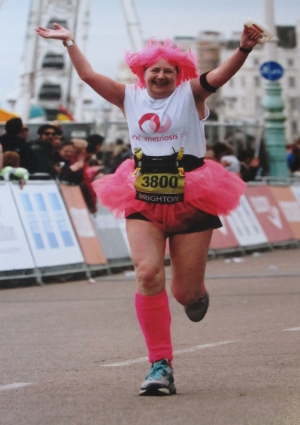
"The British 10k was very tough, but the fact I was doing it for a great charity and for every single woman out there that suffers with this cruel illness made me push through the pain and cross that finish line."
MY EXPERIENCE
I was diagnosed with Endometriosis in August 2012 via a laparoscopy. However getting diagnosed was incredibly difficult. I started showing symptoms of endometriosis when I was just 12 years old. From then up until I was 17 when I finally got diagnosed I was constantly back and forth to the doctors, paediatrics and gynaecologists. However even though I was suffering with nearly every symptom of endometriosis, I still got turned away and told there was nothing wrong with me and that I would grow out of this.
This had an impact on my education and social life as I was in constant pain. It was extremely difficult for me as I had no diagnosis. When people asked me what was wrong I had nothing to tell them as I had no idea myself what was going on apart from that I was in extreme pain. People starting to think I was making it up, which then caused me to doubt myself.
The impact endometriosis has had on my everyday life is the unpredictability of when I will get a bad flare up. This means I can’t plan things as I don't know how I will feel each day. Because of the up and downs of pain with endometriosis, it’s affected my work, social life and relationships with people. This had all caused big emotional stress as well as physical pain and problems.
EXERCISING AND FUNDRAISING FOR ENDOMETRIOSIS UK
In the last 18 months I have found exercise to be my new best friend! It’s a great way for me to relieve frustration, upset and anger. I have also notice some improvements in some of my physical symptoms since I have been exercising and improving my general health and fitness.
I was due to take part in Endometriosis UK's Pink Pants Snowdon Horseshoe Challenge; however, due to complications following a laparoscopy I was unable to take part. Not taking part in the Snowdon challenge was really devastating for me as I was really looking forward to pushing myself in that challenge. However this made me more determined to do the British 10K run and has spurred on my recovery as I am not going to let endometriosis stop me from doing another thing I feel very passionate about. Getting back into training was hard both mentally and physically especially as I had been out of exercise for a few months.
On the day of the race my endometriosis pain had flared up a bit but I was determined to not let that get in the way! The British 10K was very tough, but the fact I was doing it for a great charity and for every single woman out there that suffers with this cruel illness made me push through the pain and cross that finish line. Crossing the finish line was such an emotional and amazing feeling! Considering everything my body had been through just a couple months before the race including major surgery and bad complications afterwards, I was so proud that I didn't give up and I did it! And I am really hoping to take part in a half marathon next year for Endometriosis UK!
I chose to support Endometriosis UK because it’s a charity I feel very passionately about and that helped me a lot when I first got diagnosed.
- Kim
Sarah's Story
“Nobody should be frightened to be assertive and appropriately persistent about their health concerns.”
MY EXPERIENCE
I’d been experiencing increasingly severe pelvic pain throughout the month, gastric pain and bloating, lower back pain and very bad period pain for about a year. As the months went by the pain began to have a significant effect on my daily life, with me often bent double and struggling to walk on the evenings.
Because my symptoms lasted all month and my periods were regular and not heavy, my GP felt there was no gynaecological issue. When both an ultrasound and a colonoscopy failed to show anything abnormal, the doctors began to imply my condition was entirely psychosomatic! It was a very stressful and frustrating period of time for me. I knew my symptoms were not normal and were worsening. I became very worried that something serious had been missed. I had also been trying for a baby for around a year with no success and worried that this was connected to my symptoms.
HOW I GOT DIAGNOSED
Rather than continue with this stressful situation, I made the decision to change GP practice and this turned out to be a great move. After sharing what I’d been experiencing, it was suggested that I may have endometriosis and I was immediately referred for an outpatient gynae appointment.
After performing an examination and hearing my history, the consultant suggested a diagnostic laparoscopy. This was performed a couple of months later. Small implants were found in several places at the back of my uterus, on my utero-sacral ligaments and in the Pouch of Douglas. I wasn’t surprised when endometriosis was confirmed. I had done lots of reading already on the Endometriosis UK website after it was mentioned by my new GP and was fairly convinced I had the condition. In total it took about a year to be diagnosed with endometriosis.
FOLLOWING MY DIAGNOSIS
I took the progesterone-only pill for a three month period up to my wedding then came off and immediately became pregnant. I remained symptom free until well after my second child was born in July 2012, the pregnancies having had a dramatic effect on my pain levels.
I am unfortunately awaiting further referral to the pelvic pain clinic as my symptoms are returning. At least knowing what is causing my symptoms also allows me to seek and use appropriate pain relief from my GP and to plan ahead with this condition in mind.
Nobody should be frightened to be assertive and appropriately persistent about their health concerns. Endometriosis is a complicated condition and can obviously present in many different ways; I was very lucky to be diagnosed so quickly.
The impact this condition was having on my physical and emotional well-being and the uncertainty about what was causing my pain was awful. If I hadn’t persisted in the way I did I may not have regained my fertility or been able to have treatment so quickly. I hope that other women can take some hope from my story in that although this is not a pleasant diagnosis to receive, knowledge is power and knowing what you are working with can allow you to move forward.
– Sarah
Deborah's Story
“So many people were so supportive of me doing the challenge – it was an incredibly emotional journey.”
MY EXPERIENCE OF ENDOMETRIOSIS
I had always suffered with painful heavy periods. I was just given painkillers and told by doctors I was just being a bit sensitive. I was diagnosed with endometriosis and adenomyosis when I was 40. I had two laparoscopies, which alleviated my symptoms, but only for a short while. Three weeks out of four I was ill. I had heavy bleeding, tiredness, a bloated tummy, an upset stomach, terrible headaches and sweats, as well as unbearable stomach and lower back pain. I would experience awful sickness and was very emotional. I had to carry an emergency kit of spare pants, tights and baby wipes as I was constantly having accidents.
I had a hysterectomy just six months before climbing Mount Snowdon for Endometriosis UK.
WHY I DECIDED TO FUNDRAISE FOR ENDOMETRIOSIS UK
I decided to fundraise for Endometriosis UK as the organisation were really supportive. I used the Endometriosis UK forum as sometimes no one really understood what I was going through. Following my hysterectomy, I felt so much better and really wanted to give something back to Endometriosis UK. I also wanted to show other women that you may have endometriosis but it doesn't have to have you – you can have a life with endometriosis.
I can't believe that six months after my surgery I climbed a mountain, when before I could barely work or stand.
SMASHING MY FUNDRAISING TARGET
Once signed up for the Snowdon Horseshoe Challenge, I used social media to tell friends about endometriosis. Many friends were shocked about its side effects and had seen first-hand how ill I had been, so I just constantly sent tweets and made posts on Facebook. I made sure that every time anyone donated, that I personally thanked them. I contacted the local paper, which wrote a great article that linked to my Facebook page and I received lots of donations.
I also got permission from my manager to do a bucket collection in shop I work in. Some colleagues and I wore Endometriosis UK T-shirts and spoke to the customers about endometriosis. People were very happy to support me.
My top tip is to keep talking about your fundraising and to update everyone on your training using social media.
Climbing Mount Snowdon was like the huge mountain I climbed every day before I had my hysterectomy. So many people were so supportive of me doing the challenge – it was an incredibly emotional journey. On the day, I didn't feel like I would make it, but sheer determination and the support I got from the other walkers got me there. I did it – and I felt amazing!
– Deborah
Carol's Story
"After years of suffering, I wanted to raise money for Endometriosis UK and to help make more people aware of endometriosis."
WHY I CHOSE TO FUNDRAISE FOR ENDOMETRIOSIS UK
After 8 years of struggling to find out what was causing all the pain that I was having, I was told I have endometriosis. After years of suffering, I wanted to raise money for Endometriosis UK and to help make more people aware of endometriosis. Even though I still have good days and bad it’s good to know what it is and that there is help out there, and through this I can help others that are still suffering.
HOW IT WENT ON THE DAY
After having a lovely weekend in Brighton with my husband, the day arrived for the race and what a nice day it was! With nerves kicking in, I went with the crowd. Around the 18 mile mark I was met with a wave and a cheer which made my date, With a short stop for a photo I carried on fighting through the pain as my endometriosis pains had started to kick in, but gritting my teeth I carried on. I was slower than I planned, but I did manage to knock off ½ hour from last years’ time. Roll on next year!
– Carol
Alison & Natalie's Story
"What kept me going the most was thinking of Natalie, her pain (both physical and emotional) – caused by endometriosis – is far greater than any pain that the marathon course could throw at me."
NATALIE'S STORY
All through college and early work years I remember struggling through heavy painful periods, but I thought it was normal. I thought I just had a low pain threshold as none of my other friends seemed to have to miss lectures to go home early to change their clothes.
I was officially diagnosed with endometriosis in 2009. I had never even heard of the condition. I was told I had lots of endometriosis and was ‘in a bit of a mess.’ I have endometriosis covering my ovaries, fallopian tubes, my colon and in the Pouch of Douglas. I’ve been told it is unlikely I will be able to conceive naturally. So far the IVF treatment (three attempts) I have had has been unsuccessful.
Endometriosis affects me every day. Although I am lucky not to be in physical pain every day, it is an emotional rollercoaster. My husband is very supportive and I pray that one day we will achieve our dream of raising a child. I was bursting with pride when Alison ran the marathon.
It means so much when people recognise the pain I am going through and try to support me. Endometriosis UK is an amazing charity they were the first place I turned to for answers when I was diagnosed. They made me realise I was not alone and they have been there every step of the way with support and information.
– Natalie
ALISON’S STORY – WHY I RAN THE MARATHON FOR ENDOMETRIOSIS UK
I have only run short distances for the past 4 years, so it was a big challenge to push myself to run a marathon. I chose to run for Endometriosis UK because I knew I needed something that would pull me through the miles! It was an easy decision to run the marathon for Endometriosis UK and my sister Natalie – she is an inspiration.
Natalie has been through so much emotional and physical pain because of endometriosis. She works as a personal carer for people with disabilities, which can be a physically demanding job, but she never complains and has so much inner strength it’s unbelievable.
During the marathon I saw Natalie in the crowd at mile 18; everything was hurting and I felt like I was running on empty. I ran over and gave her a big (sweaty) hug. We both started crying and she said, 'Come on I know you can do it!'
I was so proud to complete the course in honour of her and all endometriosis sufferers.
It was an amazing day, full of emotion and memories that I am sure will last a life time. I will be wearing my medal for a while I think!
– Alison
Elizabeth's Story
"I haven't given up on the dream of being a Mum, but somehow I have found peace and acceptance for the person I am and the couple we are."
MY EXPERIENCE
I don’t remember a time when I didn’t want to become a mum. Duncan and I married in 2001; excited about our future together and the family we would have. We’ve lost 7 pregnancies in total.
I’ve lost track of how many medications and tests I have endured, with fertility clinics and gynaecologists. Infertility can seem like you are on a hamster wheel – getting nowhere fast. I have begged for help. At times I have been in so much pain I didn’t know how I would be able to get out of bed and function the next day.
Despite suffering from heavy and excruciatingly painful periods since I was 10 years old, I wasn’t diagnosed with stage 4 endometriosis until I was 31. This was 10 years after my first miscarriage. The consultant told me it was one of the worst cases of endometriosis he had ever seen. I was advised that they were unable to see my womb, ovaries or tubes. It was not possible for them to remove any endometriosis or see the extent of the damage to my bladder or bowel.
I was initially offered Zoladex to shrink the endometriosis enough for me to have some of the tissue removed from my fused tubes, they were optimistic that this would give us a window of 3 months to try and conceive a baby. This optimism was short lived and at our next appointment we were advised that the endometriosis was the reason for my recurrent miscarriages. My body rejected the egg, treating it as if it was endometriosis.
WHY I DECIDED TO HAVE A HYSTERECTOMY
In 2011 I had a total abdominal hysterectomy, bilateral salpingoophorectomy and a bowel resection. Opting to have a hysterectomy was not a decision made lightly. Seeing my hysterectomy as being the best chance of having a happy healthy future and to get a quality of life that had never been available to me. Mentally and physically I was ready to draw a line under what has been the most difficult time of our lives.
Three years on I can honestly say I wasn't prepared for the difficulty of coming to terms with losing my womanhood, experiencing some of my darkest days. Naively I thought this side would be easier. It has challenged our marriage and the relationship I have with myself.
INFERTILITY AND PARENTHOOD
For 10 years we chased the dream. We’ve applied to be adoptive parents multiple times; each time it wasn't meant to be. We’ve investigated surrogacy, which has also eluded us.
My identity as I grew up was always around being a Mum; it's hard to break something that is as intrinsic as breathing. I haven't given up on the dream of being a Mum, but somehow I have found peace and acceptance for the person I am and the couple we are. I still struggle to see myself as a woman, perhaps I never will.
Infertility makes you question whether you are worthy of parenthood & happiness, challenging your right of passage through life. It’s always present – new pregnancy announcements, christenings, visiting nieces and nephews (of which we are incredibly blessed to have the best in the world). It's always us that leaves empty handed with a lonely heart, but we wouldn't miss being part of their lives for anything.
Life might not have been what we had planned, but there have been many highs along the way. This year I will celebrate 13 years of marriage to my best friend who makes me laugh and my heart sing; I graduated from university as a mature student; I have gotten further in my career than I ever thought possible; I can ride a motorbike and, finally, I don't have any periods!
I hope that my story will help others with their pathway through this illness and that in time to come there will be a cure for endometriosis.
- Elizabeth