New research highlights inequalities in endometriosis diagnosis times for women and those assigned female at birth from ethnically diverse communities across the UK:
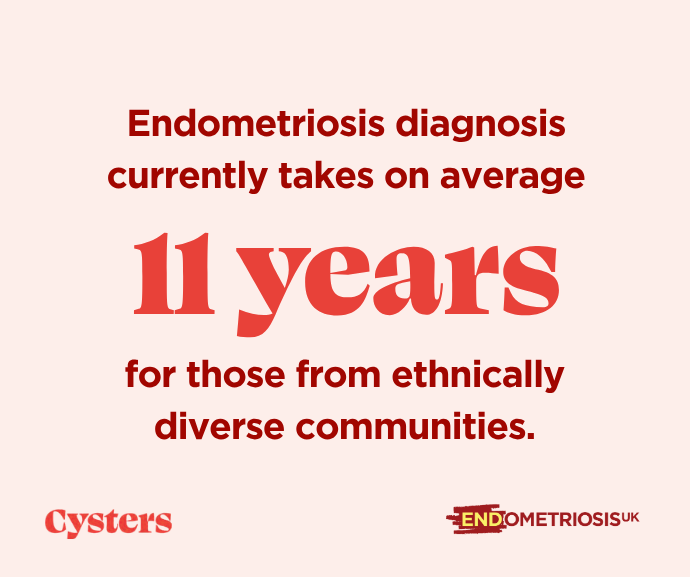
- People from ethnically diverse communities wait, on average, 11 years for an endometriosis diagnosis in the UK
- This is compared to the UK-wide average diagnosis time of 9 years and 4 months
- Patients from ethnically diverse backgrounds wait more than twice as long (4 years) between seeing a gynaecologist and being diagnosed with endometriosis as the UK-wide average (1 year and 10 months)
- This is despite going to their GP sooner after first noticing symptoms, and waiting less time to see a gynaecologist
- More than two thirds (68%) believed their ethnicity either played a role in their diagnosis, proved a barrier to diagnosis, or was the subject of assumptions made by healthcare practitioners
- Just 11% believed healthcare providers are culturally sensitive
A new report, jointly produced by charities Cysters and Endometriosis UK sheds light on the biases and inequalities faced by endometriosis patients from ethnically diverse communities.
Disbelieved, Dismissed, Delayed: Endometriosis Diagnosis Inequalities in Ethnically Diverse Communities reveals that patients from these communities are waiting more than 16% (1 year and 8 months) longer than the UK average waiting time for an endometriosis diagnosis time.
The report draws on findings from more than 500 people from ethnically diverse communities living with endometriosis, as well as ten supplementary interviews. These were conducted to address limitations in Endometriosis UK’s diagnosis report, The state of endometriosis care across all 4 nations (2026), of which 93% of respondents were from white ethnic backgrounds.
Responses to the survey and interviews highlight issues such as: racist myths and assumptions; gaslighting, dismissal and disbelief from healthcare professionals; normalisation of pain; and feeling that they were treated differently from white patients.
Neelam Heera Shergill, CEO of Cysters, said: “This report shows a truth our communities have lived with for far too long, that the delay is not just clinical, it is structural. When people from ethnically diverse communities are seeking help sooner, yet waiting longer for answers, we have to ask what is really being assessed, the symptoms, or the person in front of the clinician. Eleven years is not a statistic, it is years of pain, dismissal, and lost trust in a system that should care.
As a South Asian woman impacted by this myself, I feel this both personally and professionally, and I feel a deep responsibility to push for change. Until healthcare truly listens, reflects the communities it serves, and confronts its own biases, these delays will continue to cost lives, livelihoods, and dignity.”
Emma Cox, CEO of Endometriosis UK, said: “It is shocking that it currently takes 9 years and 4 months on average to get a diagnosis in the UK, and indefensible that it takes 11 years on average for those from ethnically diverse communities. Throughout this report, racial bias has been highlighted as a key concern. More than two thirds (68%) of respondents believed their ethnicity played a role in their diagnosis, proved a barrier to diagnosis, or was the subject of assumptions made by healthcare practitioners. Governments must tackle racial bias as a priority and ensure mandatory training is delivered across the NHS workforce.
Collectively we must now work to tackle the inequalities faced and ensure this becomes a Government priority. Through this report, we provide ways in which Governments can and must do better. This must be the start of the conversation, not the end, and we look forward to working with Governments and NHS’s in each nation to ensure that these recommendations become a reality.”
Sarah Harris, Trustee of Cysters and Lead Researcher on the report, said: “Whilst it’s encouraging to see an increase in research surrounding endometriosis over the last few years, there is still a noticeable gap within those involved in and responding to these studies. Endometriosis can impact those from all backgrounds, and therefore it is important that this is represented in research on the disease.”
“Although for many years it has been presumed that those from ethnically diverse populations have a longer journey to diagnosis of endometriosis, this sentiment has rarely been portrayed in research. This report proves what we knew all along; now it is our job to work towards changing this.”
Case studies - available for interview on request
Zaynah Ahmed, 20: “As a young person, and a woman of colour, I was often dismissed and told I would grow out of it. Getting a diagnosis meant I was finally able to understand what was going on with my body”.
Sanchia Alasia, Trustee of Endometriosis UK: “It took me more than ten years to be diagnosed with endometriosis. I first went back and forth to a family doctor from the age of 13, but my symptoms were repeatedly dismissed as ‘just heavy periods’. Over the years I was even told I simply had a low pain threshold, when in reality I was living with debilitating symptoms that were never investigated. That long delay not only affected my health but left me feeling unheard and unsupported. Sadly, my experience reflects what so many from ethnically diverse communities still face — a constant battle to be believed”
Read the report: Disbelieved, Dismissed, Delayed: Endometriosis Diagnosis Inequalities in Ethnically Diverse Communities